
Sinking of the Titanic
1912
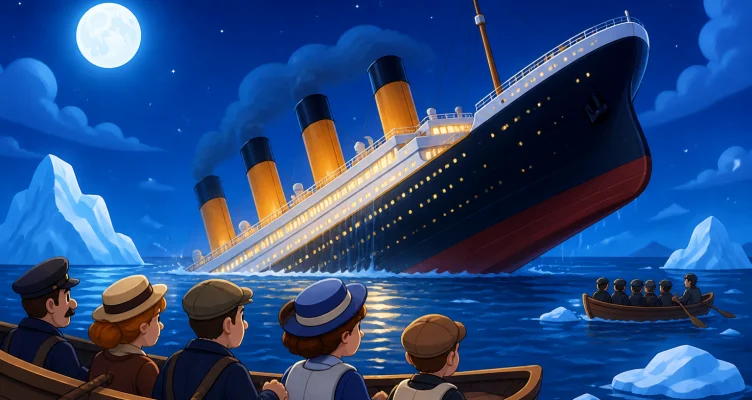
The event in detail
RMS Titanic sank in the North Atlantic Ocean on 15 April 1912. The largest ocean liner in service at the time, Titanic was four days into her maiden voyage from Southampton, England, to New York City, United States, with over 2,200 people on board when she struck an iceberg at 23:40 (ship's time) on 14 April. She sank two hours and forty minutes later at 02:20 ship's time (05:18 GMT) on 15 April, resulting in the deaths of between 1,490 and 1,635 people, making it one of the deadliest peacetime maritime disasters in history.
Titanic's wireless operators received seven warnings of sea ice leading up to the night of 14 April, but was travelling at a speed of roughly 22 knots (41 km/h; 25 mph) when her lookouts sighted the iceberg. Unable to turn quickly enough, the ship suffered a glancing blow that buckled the steel plates covering her starboard side and opened six of her sixteen compartments to the sea. Titanic had been designed to stay afloat with up to four of her forward compartments flooded, and the crew used distress rockets and wireless messages to attract rescue vessels as the passengers were put into lifeboats.
In accordance with existing practice of the day, Titanic's lifeboat system was not designed to hold everyone on board simultaneously, but rather to ferry passengers to nearby rescue vessels; therefore, with the ship sinking rapidly and help still hours away, there was no safe refuge for many of the passengers and crew, as the ship was equipped with only twenty lifeboats, including four collapsible lifeboats. Lack of preparation for the evacuation, lack of time, and the difficulty in getting passengers to board the lifeboats meant many were launched before they were completely full, and two boats were not launched at all, instead floating off the ship and becoming a refuge for survivors in the water.
Titanic sank with around 1,500 passengers and crew still on board. Almost all of those who ended up in the water died within minutes due to the effects of cold shock and hypothermia, with only around 40 being eventually rescued by nearby lifeboats. RMS Carpathia arrived about an hour and a half after the sinking and rescued all of the 710 survivors by 09:15 on 15 April. The disaster shocked the world and caused widespread outrage over the shortage of lifeboats and lack of vigilance given to ice warnings the ship had received. Further outrage was aimed at SS Californian who, despite being the closest ship, missed the Titanic's distress calls due to having only one wireless operator aboard. Subsequent inquiries recommended sweeping changes to maritime regulations, including leading to the establishment of the International Convention for the Safety of Life at Sea (SOLAS) in 1914 which still governs maritime safety today.